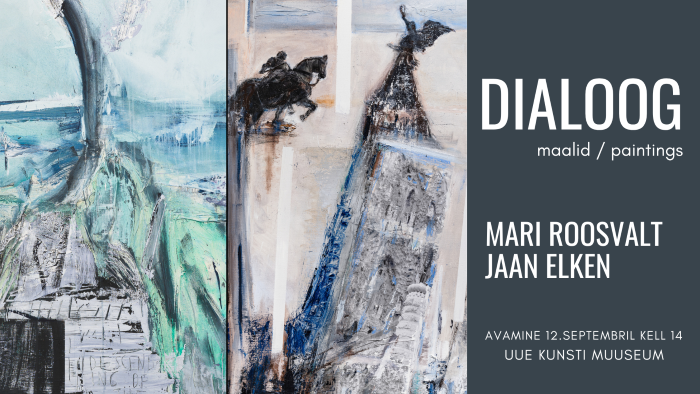
“Dialogue” is a selection exhibition of the artistic journeys of Mari Roosvalt (b. 1945) and Jaan Elken (b. 1954), most of which falls within the last 25 years of work, with a few exceptions from the 1990s.
The title of the working version of the exhibition was MAP AND TERRITORY: point of (no) return, which was replaced with the more compact DIALOGUE during the work, the content remained the same. The rough-borrowed, ‘geopolitical’ construction of the working version helped to map the material being discussed – based on the artists’ repositories, it is still possible to create very different productions.
The creative activity of both artists, in other words the frequency of their appearances at exhibitions, has been high, being one of the reasons why the handwritings/painting manners are still in the work-in-progress stage.
The “total transformation” would be more prominent if the period in question were stretched out to the maximum length, but even a quarter of a century of discontinuous adaptation to the rooms of the second floor of the University of Tallinn forces us to leave out entire chapters.
Jaan Elken, who debuted as a hyperrealist at the 1978 Tallinn Art Hall spring exhibition, had an abundance of bold spatula and brush strokes with pasty paint, writing with paint squeezed from a tube, paper blanks and photo posters glued to the canvas surface, and other expressionist techniques.
Mari Roosvalt’s exhibition activity began somewhat earlier, also in the 1970s. Roosvalt’s first solo exhibition at the Tallinn Art Gallery was in 1979 (Elken there in 1980). In her new-objective still lifes and figurative settings, the use of staffage in the framework of geometric art and the presence of abstract art have subsequently become eloquent (“Old Objects”, 1981; “Red Chairs”, 1981). Abstract art, or absolute art (as abstract expressionism has also been called), gained a new lease of life in the Estonian painting field since the late 1980s, and it adapted and/or mutated into something even crazier based on the unwritten rules of the art field. Mari Roosvalt’s retreat was to integrate newspaper clippings into a fresh painting surface, which she replaced a few years later with digital prints of the surroundings created from photographs. In this way, endless possibilities opened up for the artist to continue with paint, although in essence he had long since left the veil of abstract painting.
In a sense, both artists acted as saboteurs of postmodernism in the field of abstract art – Jaan Elken integrated foreign textiles from arte povera, Soviet-era state flags and ready-made slogans into the field of painting, or wrote square meters full of calligraphic mishaps to perfect stencil-written command sentences.
Jaan Elken’s works are in the collections: Jane Voorhees Zimmerli Art Museum (Rutgers, The State University of New Jersey. The Norton and Nancy Dodge Collection of Nonconformist Art from the Soviet Union), United States; CAM_Casoria Contemporary Art Museum, Naples, Italy; Tretyakov Gallery, Moscow, Russia; Matthew Bown Gallery, London, Great Britain; European Parliament, Brussels, Belgium; Estonian Art Museum; Tartu Art Museum; Estonian Museum of Culture; Estonian Artists’ Association Collection (formerly Art Fund Collection); Viinistu Art Museum; Museum of New Art in Pärnu, etc. in collections and private collections around the world.
Mari Roosvald’s works are in the collections of: Art Museum of Estonia; Tartu Art Museum; Estonian Artists’ Union Collection (formerly Art Fund Collection); Tallinn City Art Collection; Ministry of Culture of the Russian Federation; Guadalajara Art Museum, Mexico; private collections in Estonia, Finland, Sweden, Australia, the United States.
September 12 – October 18, 2026 at the Museum of New Art, Pärnu
The exhibition is supported by the Cultural Endowment of Estonia and the City of Pärnu