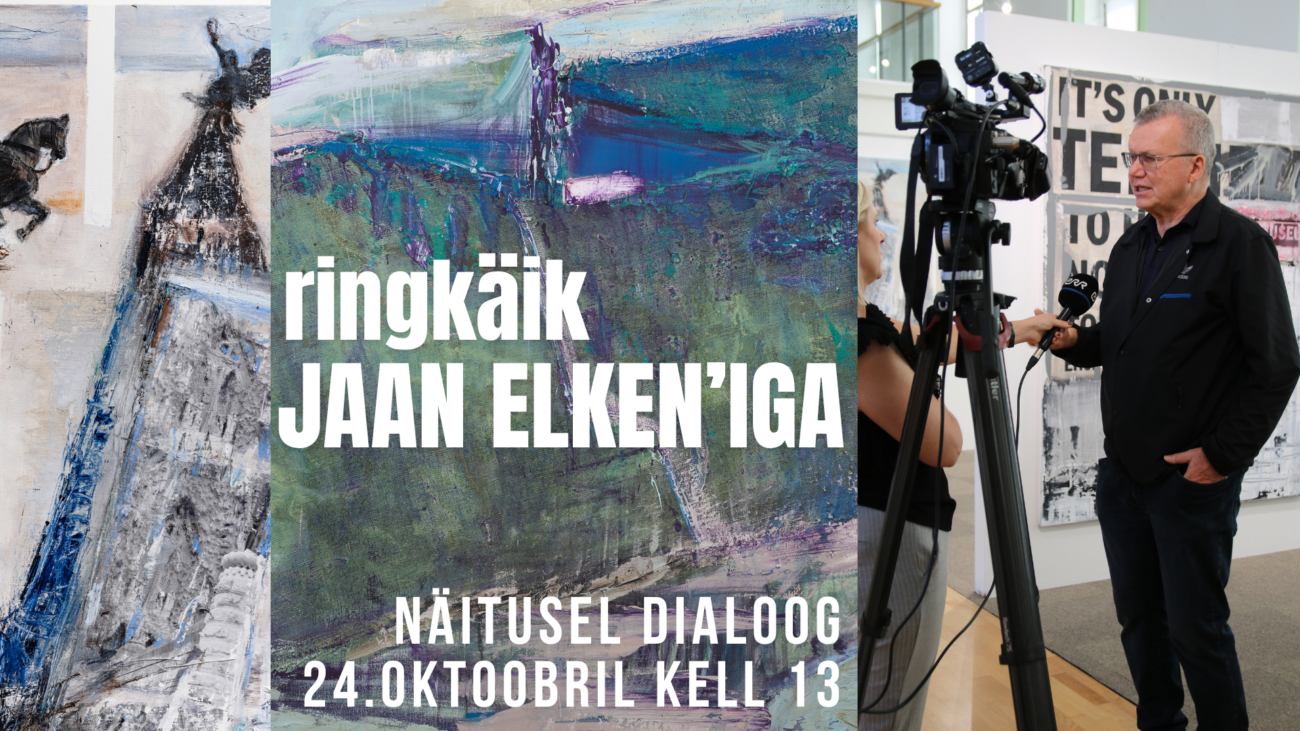
The Museum of New Art invites you
on Saturday, 24 October, at 13:00
to Jaan Elken’s guided tour of the exhibition DIALOGUE!
Exhibition DIALOGUE
“Dialogue” is a selected exhibition drawn from the artistic careers of Mari Roosvalt (b. 1945) and Jaan Elken (b. 1954). Most of the works date from the last 25 years, with a couple of exceptions from the 1990s.
Admission to the guided tour is with a museum ticket; free with the Museum Card.
The working title of the exhibition was MAP AND TERRITORY: point of (no) return, which in the course of the work was replaced by the more compact DIALOGUE; the content remained the same. The working title’s loosely borrowed, ‘geopolitical’ construction helped to map the material being explored – the artists’ storerooms still allow for very different stagings.
Both artists have been highly active creatively – in other words, they have exhibited very frequently – which is one of the reasons why their handwriting/painting manners are still at the work-in-progress stage.
“Total transformation” would stand out in sharper relief if the period covered were stretched as far as possible, but even fitting a fragmentary quarter of a century into the second-floor rooms of the Museum of New Art forces whole chapters to be left out.
Jaan Elken made his debut as a hyperrealist at the spring exhibition of the Tallinn Art Hall in 1978, and all his paintings of that period (“At the Corner of Koidula and Leiner Streets” (1977/1978), “Unsigned” (1978) and others) abound in bold palette-knife and brush strokes in impasto paint, writing with paint squeezed straight from the tube, paper forms and photo posters glued onto the canvas, and other devices of expressionism.
Mari Roosvalt began exhibiting somewhat earlier, also in the 1970s; her first solo exhibition was held at the Tallinn Art Salon in 1979 (Elken’s at the same venue in 1980). In her New Objectivity still lifes and figurative arrangements, what has become telling in retrospect is the staffage drawn from the vocabulary of geometric art and an easy familiarity with abstract art (“Old Objects”, 1981; “Red Chairs”, 1981).
Abstract art, or absolute art (as abstract expressionism has also been called), gained a new lease of life in Estonian painting from the late 1980s; at the same time, following the unwritten rules of the art field, it adapted and/or mutated into something far wilder.
Mari Roosvalt’s path of retreat became the integration of newspaper cuttings into the fresh paint surface, which a few years later she replaced with digital prints based on photographs of her surroundings. In this way, endless possibilities opened up for the artist to continue working with colour, even though in essence she had long since stepped out from under the umbrella of abstract painting.
In a sense, both artists operated in the field of abstract art as postmodernist saboteurs – Jaan Elken integrated into the picture plane foreign textiles derived from arte povera, Soviet-era state flags and ready-made slogans, or filled square metres with writing ranging from calligraphic mishaps to imperative sentences in perfect stencil lettering.
Jaan Elken’s works are held in the following collections: Jane Voorhees Zimmerli Art Museum (Rutgers, The State University of New Jersey. The Norton and Nancy Dodge Collection of Nonconformist Art from the Soviet Union), United States; CAM_Casoria Contemporary Art Museum, Naples, Italy; Tretyakov Gallery, Moscow, Russia; Matthew Bown Gallery, London, United Kingdom; European Parliament, Brussels, Belgium; Art Museum of Estonia; Tartu Art Museum; Ministry of Culture of the Republic of Estonia; Estonian Artists’ Association collection (formerly the Art Fund collection); Viinistu Art Museum; Museum of New Art in Pärnu, and many other collections and private collections around the world.
Mari Roosvalt’s works are held in the following collections: Art Museum of Estonia; Tartu Art Museum; Estonian Artists’ Association collection (formerly the Art Fund collection); City of Tallinn art collection; Ministry of Culture of the Russian Federation; Guadalajara Art Museum, Mexico; private collections in Estonia, Finland, Sweden, Australia and the United States.
Exhibition open: 12 September – 31 October 2026 at the Museum of New Art, Pärnu
The exhibition is supported by: the Cultural Endowment of Estonia and the City of Pärnu
Museum of New Art
Rüütli 40a, Pärnu
open Wed–Sun 11–18