Jaan Malin writes about the exhibition DIALOGUE
Mari Roosvalt and Jaan Elken
ARTISTS’ MUSICA SACRA
In terms of form, Jaan Elken and Mari Roosvalt are of course expressionists, but the longer you look at their exhibition “Dialogue” (Museum of New Art, Pärnu, 12 September – 31 October 2026), the more reflective, troubled and at times ironic they seem. It is very strange that Mari Roosvalt had never before struck me as someone particularly worthy of attention. Now I saw how big and fundamental a mistake that had been. I promise, above all to myself, to study her work as thoroughly as I can.
I know of no more congenial pair in Estonian art today – congenial in the sense that several works in this exhibition could be attributed to either of them. At first glance, that is: the details lead you to the answer. In technical terms they are fairly similar, but on the city–nature axis, for instance, they feel at home at quite different points: Elken enjoys the city, whereas Roosvalt would rather be in a bog. Both also accept the opposite pole, but it is the ones just named that make them feel at ease.
Until October 2024 I considered the two of them rather alike and therefore uninteresting. Jaan Elken’s exhibition “Maastik / Landscape” at ARS opened my eyes; I was enthralled by it. The airiness of the high hall there and the emphatic restraint of the white walls amplified even the subtlest play of colour. I had never noticed his nuance before. But now … yes, I was enthralled. I felt something similar this time at the Museum of New Art.
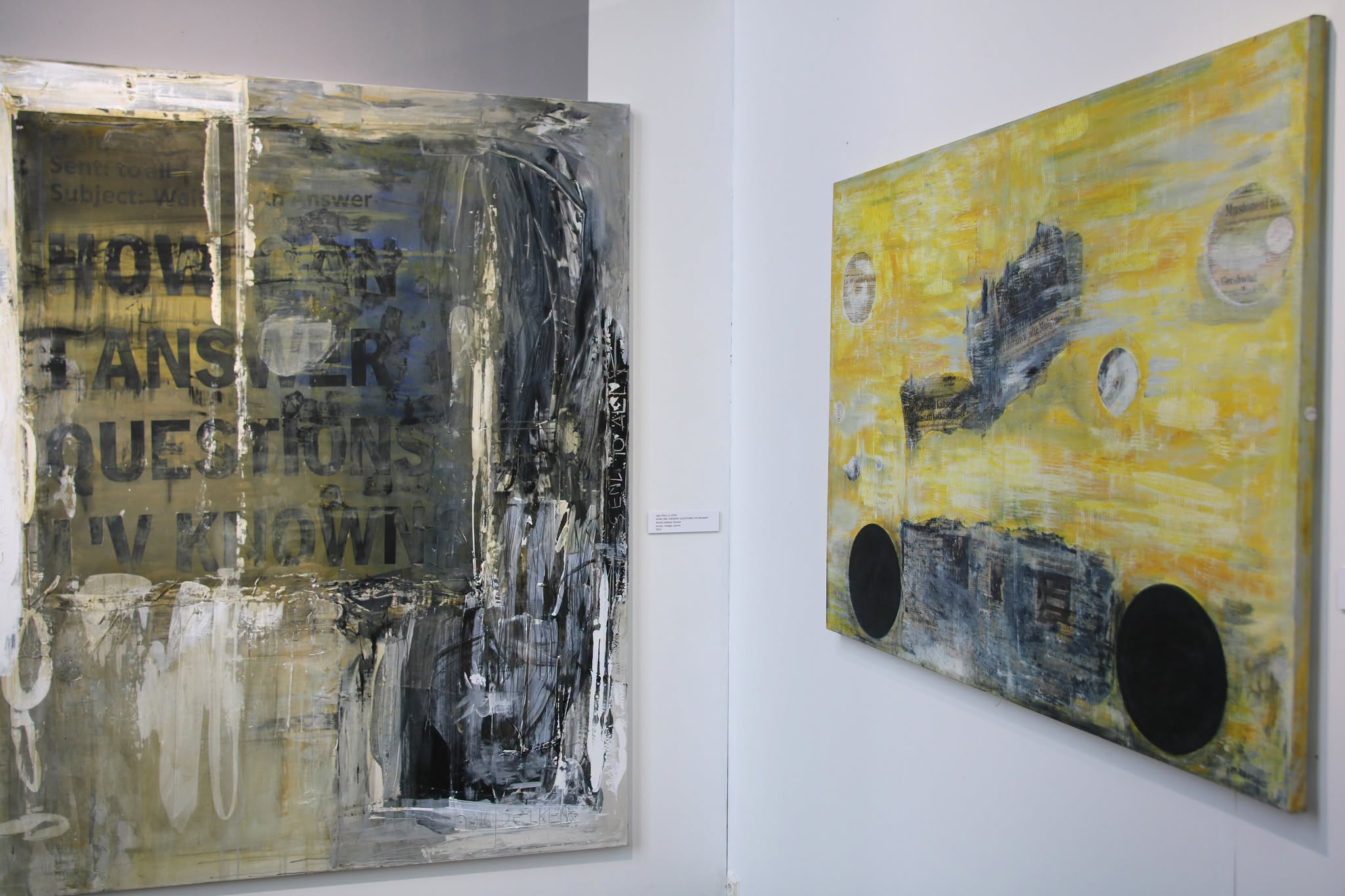
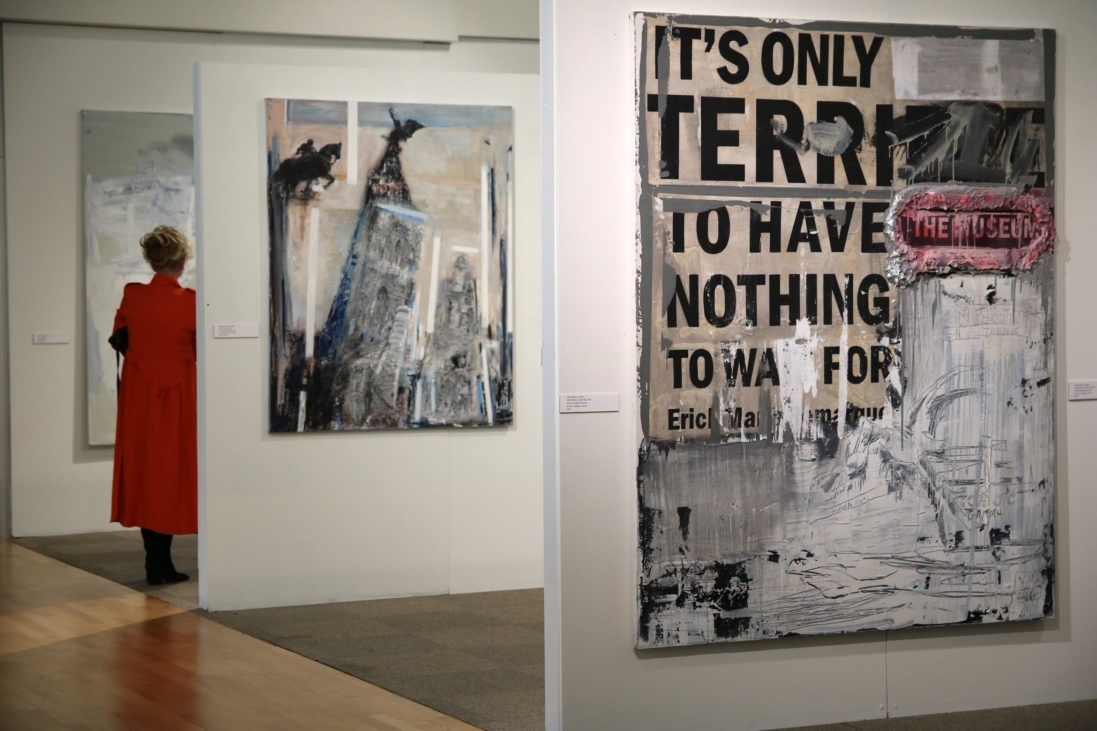
When you enter the large hall, on either side of you is Elken’s diptych “I’M THE FUNKY BROTHA, GIRLS LOVE THE JIM” from 2011. These are large, fairly monochrome paintings with text, which have long allowed me to keep my distance from Elken and walk past rather indifferently. Yet these paintings are precisely the right backdrop for what has now changed my attitude and opened my eyes. On each wall, next to Elken’s painting, hangs a work of similar character by Mari Roosvalt (“Explosion III” and “This …”), with sperm-like squiggles or other particles in Brownian motion. This wall ends with clear circles: in one corner Mari’s “Nameless man V” and in the other Elken’s “Venus”. It is a little odd to use comparisons with art, but Mari’s work seems somewhat more sensitive and hesitant, while Elken’s breaks aesthetic clichés and is utterly extrovert.
Mari’s “Nostalgia IV”, on the side wall to the right of the front door of the large hall, naturally connects with the paintings of the same format on the opposite wall, the yellow works “Vision VIII” and “Synonym IXV”. All three rest on a) the presence of a centre and b) coming to completion before the edge of the picture surface. These pictures seem to caress. The gentleness of these works softens many of Elken’s artistic blows.
It is wonderful to sit on the windowsill and look at the works in front of you: to the sides in the foreground, Mari’s “Person I”, “KU…JA…NII” and “Waiting”, and Elken’s “March 25th. Snowy”. Further back, Elken’s “Paint it Black II” (one of the most delightful favourites in this exhibition) and “Best before. Reality”, and Mari’s “Rememberment II” and “Mark IX”.
The trio from there towards the corner are all by Elken, and among them is one work (“Water I”) that had already enthralled me at the ARS exhibition. It was this very work that opened my eyes to Elken’s colourfulness and nuance. Without it, and no doubt a few other works, it would be harder to delight in the more or less hidden colour nuances of, say, “Midnight metro”, “The seventh kingdom”, “Refresh” and “Georg Ots”.
On the other side of the spiral staircase from Elken’s “Water” are Mari’s paintings “Person I” and “Mark III”. The latter proves that even a Tallinna Vesi cast-iron manhole cover can – when depicted by a master – be aesthetic. The person picture here shows the artist’s aesthetic and friendly smile at the fact that much of the life around us has been made captive to the so-called yellow press. But that won’t break us – we are still alive!
Learning from a good artist is easy on the one hand, yet dangerous on the other, because you may turn yourself into a so-called smaller version of them. Elken’s paintings “Moon-river II”, “Venus” and “Universe – master plan” convey some indefinable quintessence of a teacher. In the same role I would mention Mari’s paintings “Rememberment IV”, “Signs IV” and “Place”.
Yes, the large hall is quite instructive, but it probably demands more openness and/or knowledge of context from the viewer. In any case, for me the back hall became even more exciting and captivating. In this hall Elken is probably at his most unrestrained. I cannot describe paintings such as “Ice-cold”, “You’ve starting to believe” and “High tide” in any other way. But Mari’s “Windy”, “Meeting” and “Three ideals” are no more petty-bourgeois either.
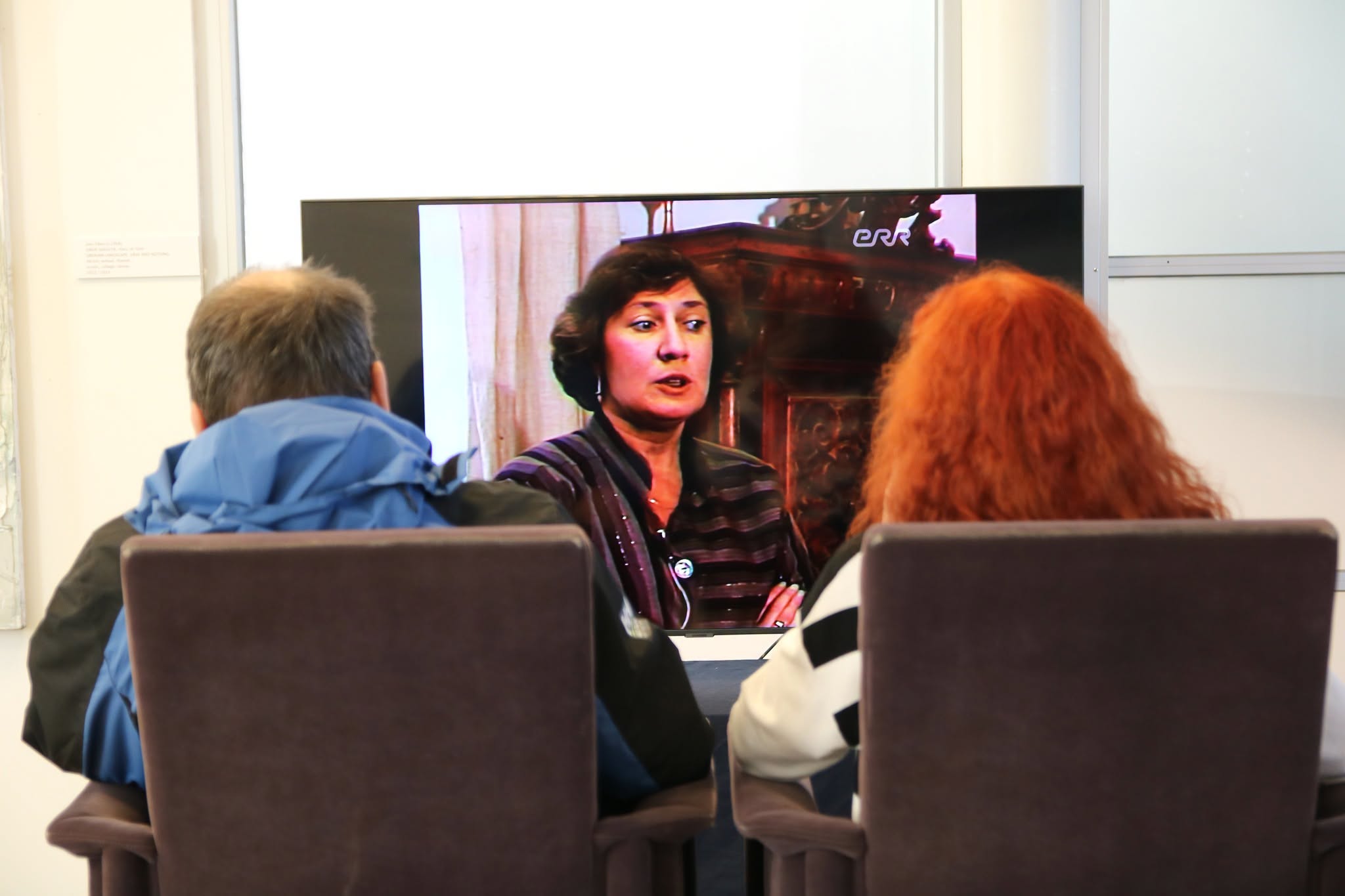
The designer’s (probably largely Jaan Elken’s) treatment of the alcove where a video has usually been shown deserves particular mention. In a sense it is like an altar or something similar. As a result, “Jesus Christ Superstar I”, looking out from the end wall of that space, takes on the significance of a true altarpiece, and this position is reinforced by its neighbours by the same artist on both sides: “Jesus Christ Superstar II” (song lyrics scratched into white paint with the end of a brush) and “J.C.S. VIII”, as well as “Poem for mattress N 2” and “Poem for mattress N 4”. I do not know how many questions the videos on view answer, but as a way of creating some context – why not.
This exhibition does not simply make you bow; it makes you crawl, practically squealing with gratitude. For a good five years I have not come across such an enthralling, cohesive exhibition, either in Estonia or elsewhere.
JAAN MALIN
The exhibition DIALOGUE is open at the Museum of New Art until 31 October 2026