Exhibition dedicated to the 90th anniversary of Jüri Arrak
04.07.-10.08.2026
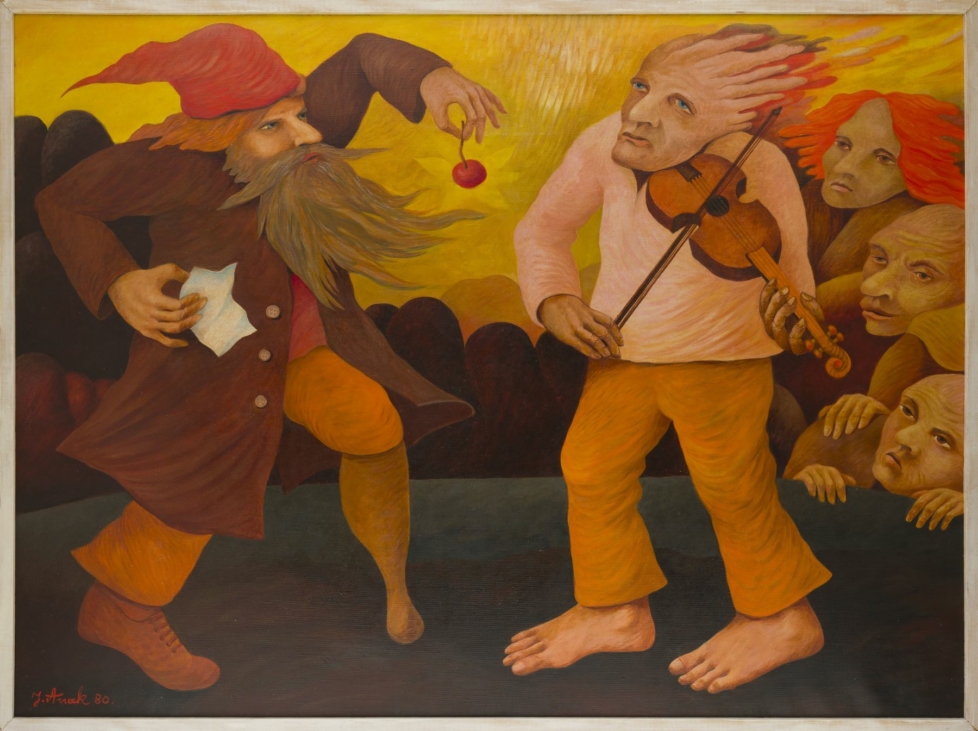
Jüri Arrak was canonized as a saint by the artist himself. His way to the other world went through Tallinn’s Kaarli Church under Johan Köler’s altarpiece, where Christ is calling to him with two open arms. The Christ on Jüri’s own painting of Halliste Church began to call already in the depths of the Soviet era, when Christianity was in disgrace. In Jüri’s soul and in his paintings, pagan and Christian ideas about our native language and our nation burned like a bright flame. Jüri was a prophet and will continue to do so in the future, because his work lives on. Jüri’s paintings of chameleons and the little red man on Kalevipoeg’s back are a warning to future generations.
In 1979, I invited Jüri to play in Bernhard Laipmann’s film “Christmas in Vigala”. During rehearsals, he had to recite Laipmann’s iconic text to the suppressors of the 1905 uprising: “I am a free Estonian man, I will not let myself be beaten and sent to Siberia. I would rather die, but I will not let myself be beaten!” The rehearsals with Jüri were left unfinished. The next morning, Jüri admitted that he could not express this thought in words. He brought me confirmation that the artist’s words resonate in his paintings. And he gave me a small picture where a little red man is sitting on Kalevipoeg’s shoulders, holding the horse’s eyes closed with one hand and is leading him to a “bright future” with the other.
Jüri did get the role in “Christmas in Vigala” – he played Bernhard Laipmann’s brother – artist Ants Laikmaa – with extraordinary vigor. Therefore, he was not shot during the filming. Bernhard Laipmann, who had insulted the tsarist regime, was shot, and was played by Evald Aavik an actor of Vanemuine theatre. Jüri’s solo exhibitions in Western Europe and the USA contributed to the restoration of the Republic of Estonia. Thus, some paintings with symbolic value have found owners whom we do not know here in Estonia. For example, the giant painting “Jonah”, where a little boy cuts open the belly of a whale with a knife and thus escapes to freedom. This motif of the Holy Scripture was a clear signal from St. Jüri Arrak to the Estonian people that we must cut open the gate to independence ourselves. The work hung in the hall of the Tallinn Art Hall for several months, everyone understood this unequivocally, no one demanded that the work be taken down.
But where has this landmark work in the history of Estonian art now disappeared to?
Mark Soosaar
Exhibition curator
Thanks to: Estonian History Museum, Tallinnfilm, Kihnu Museum and Kai Olivia Arrak.